
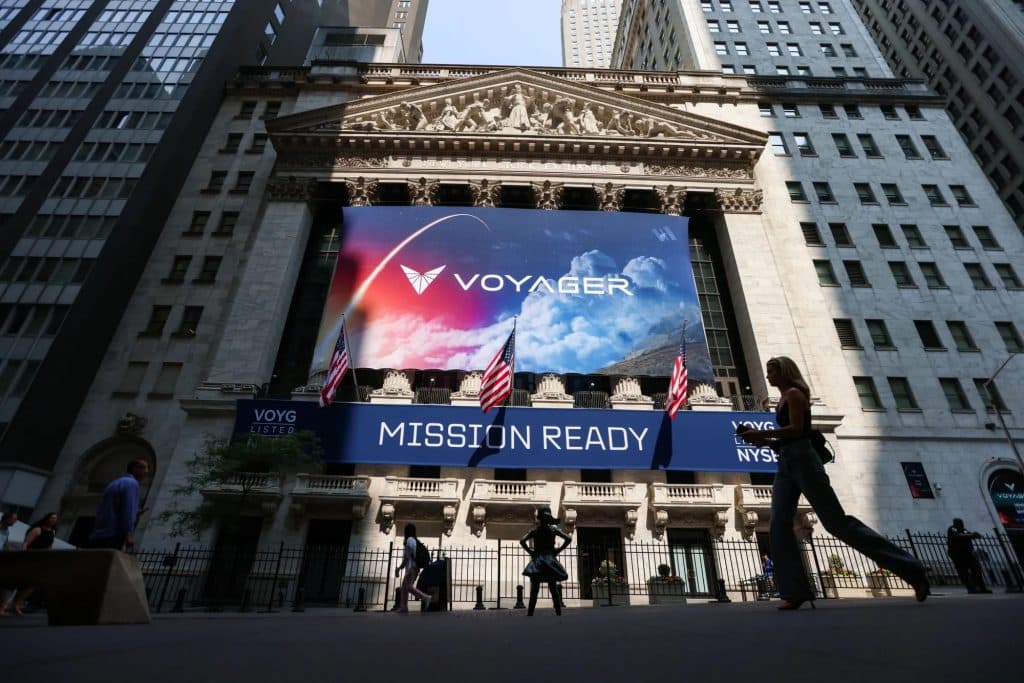


Shares of Voyager Technologies Inc. surged 82% in their trading debut after the space and defense firm raised $383 million in an upsized U.S. initial public offering. The Denver-based company’s stock closed at $56.48 on Wednesday, up from its IPO price of $31. Voyager sold more than 12.3 million shares, above the 11 million it had originally marketed in the $26 to $29 range.
The debut gives Voyager Technologies a market capitalization of $3.2 billion, based on outstanding shares disclosed in filings.
“We are both headquartered in Denver, they are across the street from us, we are friendly,” CEO Dylan Taylor said. “They are great partners and we coordinate with them closely and we have several initiatives where they play an important role.”
Voyager generated nearly 84% of its revenue in 2024 from contracts with the U.S. government and its affiliates, according to regulatory filings. The company reported a net loss of $26.9 million on $34.5 million in revenue for the quarter ended March 31, compared to a $14.8 million loss on $30.2 million in revenue during the same period last year.
Voyager could also benefit from President Donald Trump’s proposed “Golden Dome” missile defense initiative, which would use space-based interceptors.
“If the President gets what he wants for Golden Dome, that would potentially be a windfall,” Taylor said.
Republicans in Congress are advocating for $25 billion in initial funding for the project, which Trump has estimated could cost as much as $175 billion overall. Taylor added that even under a “skinny budget,” funding for commercial space stations would likely remain strong.
The IPO was led by Morgan Stanley and JPMorgan Chase & Co. Voyager shares are trading on the New York Stock Exchange under the ticker symbol VOYG. Filings also indicate that Janus Henderson Investors and Wellington Management expressed interest in purchasing up to $60 million worth of shares combined.
Founded in 2019 and recently rebranded from Voyager Space, Voyager Technologies provides services to both government and commercial clients in areas like national security, space infrastructure, and advanced technologies.
Voyager has secured a $217.5 million grant from NASA to help develop Starlab, a commercial space station intended to succeed the International Space Station, which is slated for decommissioning in 2030. The project is being carried out through a joint venture involving Airbus SE, Mitsubishi Corp., MDA Space Ltd., and Palantir Technologies Inc.
Recent tensions between Trump and Elon Musk have raised questions about SpaceX’s dominance in the sector, initially shaking investor confidence. However, Musk later walked back his remarks.
In a Bloomberg TV interview Wednesday, Taylor credited SpaceX as an essential player in the space ecosystem and said the industry thrives on collaboration.
“Really, everyone is rooting for everyone else,” Taylor said. “I mean that sincerely, because it’s important we get replacements up there prior to the International Space Station being decommissioned.”
Voyager also has close ties with Palantir, a joint venture partner on Starlab and a Voyager shareholder. Last April, Voyager issued 228,365 shares to Palantir as payment for services including the development of a scheduling prototype for ISS payloads.

 Pump Radar
 Stock Alerts