
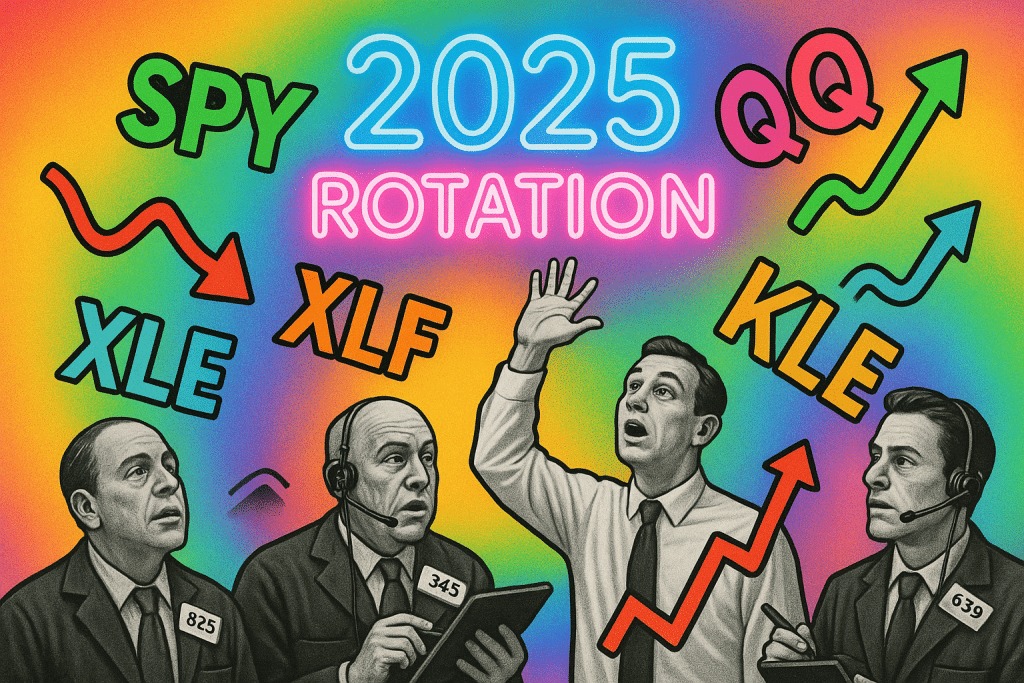


As traders obsess over tech and meme-stock headlines, something quieter – but far more telling – is happening beneath the surface of the market. Wall Street’s institutional players are repositioning. And if you’re only watching the front page of your trading app, you might miss what they’re really buying.
Forget the hype. Let’s talk about the real signals – weekly ETF flows, rotation into overlooked sectors, and the subtle but significant clues from trading desks and fund manager surveys. From SPY inflows to a stealth shift toward financials and energy, institutional sentiment is sending a very different message than retail euphoria.
ETFs Reveal a Hidden Rotation
Last week’s ETF flow data tells a nuanced story. Sure, broad-market funds like and continued to rake in cash – $20.5 billion across U.S. ETFs in total, according to ETF.com. But that wasn’t the real headline. It was the spike in flows into sector funds – especially the unloved ones – that caught sharp-eyed analysts off guard.
XLF, the Financial Select Sector SPDR Fund , pulled in a stunning $641 million in a single day, per TradingView. , which tracks energy stocks, also saw a sizable influx of capital. And small-cap tracker took in $465 million.
In other words, institutions aren’t just adding to tech – they’re quietly rotating into value sectors and cyclicals. It’s not flashy. But it’s deliberate.
Institutional Moves Don’t Match the Headlines
While retail traders are still chasing AI stocks and growth names, the pros are repositioning for something else. You can see it in early previews of 13F filings, and in reports from trading desks that cater to hedge funds and mutual funds.
Bank of America’s latest Global Fund Manager Survey offers a revealing clue. It shows a growing preference for international equities and value stocks, with over 54% of global managers now overweight ex-U.S. holdings. Meanwhile, U.S. equities – particularly the tech-heavy growth names – are seeing a cooling in sentiment.
The survey also found that hedge fund exposure to U.S. equities is becoming more defensive, with many firms layering in protection or scaling into sectors that tend to perform well in late-cycle environments.
Growth vs. Value: A Subtle Shift
This isn’t a violent rotation. But it is a significant one. The shift from growth to value isn’t about abandoning tech – it’s about hedging against risk while positioning for macro uncertainty.
Tech still dominates headlines. And yes, QQQ took in $1.4 billion last week. But that’s only part of the picture. The inflows into XLF and XLE suggest that many portfolio managers are preparing for a market where interest rates stay higher for longer – or where inflation reaccelerates.
Why energy and financials? Because these sectors tend to outperform when inflation expectations rise and when monetary policy stays restrictive. The recent uptick in Treasury yields, along with renewed fiscal spending and tariff chatter, makes this positioning look more strategic than speculative.
Cyclicals and Defensives
There’s also a creeping interest in cyclicals – industrials, financials, energy – and defensives, like health care. Sector ETFs such as saw steady if modest inflows, indicating that some investors are building hedges against a potential market pullback.
This diversification away from concentrated bets on tech momentum is telling. It speaks to a broader narrative: not fear, but discipline.
Even as stocks hit new highs, institutions are preparing for a messier second half of 2025 – one marked by policy risk, slower growth, and more volatility. They’re not fleeing equities. They’re rotating.
How This Differs From Retail Behavior
Retail investors are still largely chasing performance. Call option volumes remain elevated, and many are overweight high-beta tech. Robinhood’s top 10 list still reads like a who’s-who of speculative darlings.
That’s not to say retail is wrong – but they are leaning into risk at a time when institutional money is trying to neutralize it.
When pros rotate into value and cyclicals while retail pushes further into speculative growth, the divergence often signals a transitional phase in the market. One group is thinking about next quarter. The other is watching the next candle.
Key Sectors to Watch This Week
If you want to track institutional behavior in real-time, watch these tickers:
- XLF (Financials): Last week’s flows suggest banks and insurers could see further strength if yields rise or if the Fed stays on hold.
- XLE (Energy): Inflation hedging and geopolitical tension could keep energy in favor.
- IWM (Small Caps): A contrarian play that’s drawing capital despite underperformance—a signal that some funds are betting on a mean reversion.
- XLV (Health Care): Defensive positioning that suggests concern about future volatility.
- Also keep an eye on international ETFs – especially those with emerging market or Europe exposure – as more managers seek diversification away from a U.S.-centric portfolio.
The Bottom Line: Watch What They Do, Not What They Say
The data is clear: Wall Street’s biggest players are making moves that contrast sharply with the surface-level optimism. They’re not panicking – but they’re positioning with precision.
ETF flow data is a window into those decisions. If you know where to look, it tells a very different story than the headlines about “unlimited upside” or “AI booms.”
So while everyone’s watching tech tickers and meme stock tweets, you’d be wise to track fund flows, sector rotation, and survey sentiment. That’s where the smart money shows its hand.
Because on Wall Street, the loudest trades aren’t always the most important ones. The quiet moves are the ones that count.

 Pump Radar
 Stock Alerts