
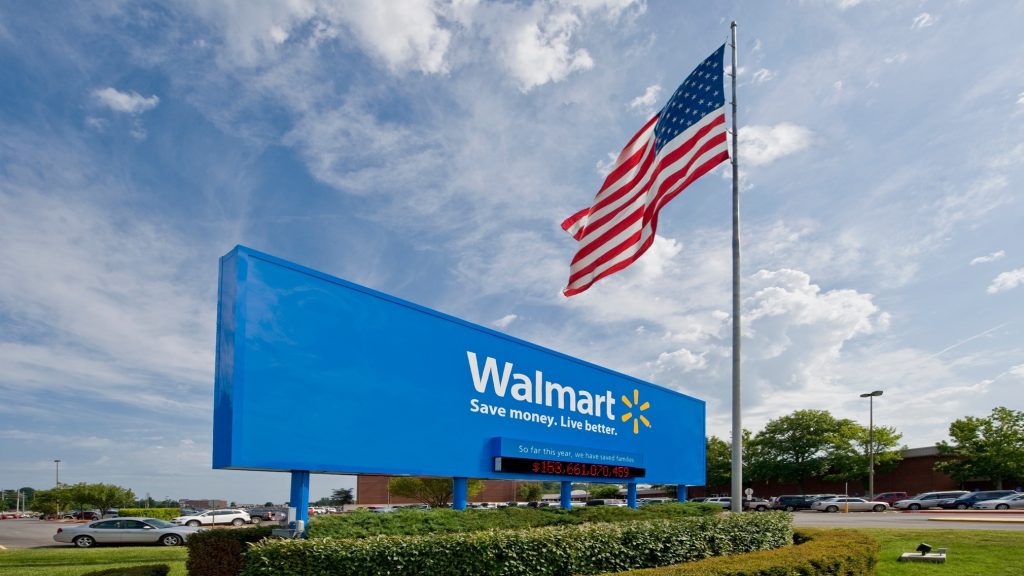


Walmart on Thursday raised its full-year earnings and sales guidance, even as the retail giant warned that costs from higher tariffs continue to climb. The announcement comes after another quarter of double-digit growth in its e-commerce business, highlighting the company’s resilience amid rising expenses.
The big-box retailer beat Wall Street’s revenue estimates for the fiscal second quarter but fell short on adjusted earnings per share (EPS) for the first time since May 2022. Profit pressures included one-time items such as restructuring costs, higher insurance claims, and litigation settlements. Walmart now expects fiscal-year net sales to grow 3.75%–4.75%, up from a prior forecast of 3%–4%, and raised its adjusted EPS guidance slightly to $2.52–$2.62, compared with $2.50–$2.60 previously.
CFO John David Rainey told CNBC that Walmart is working to maintain low prices by accelerating overseas imports and increasing in-store Rollbacks (limited-time discounts). “This is managed on an item-by-item and category-by-category basis,” he said. “There are areas where we’ve fully absorbed higher tariff costs and others where some costs have been passed along.” Rainey added that tariff-driven costs are still climbing, but consumer spending has remained steady. Private-label sales, for example, were largely flat year over year.
CEO Doug McMillon noted that middle- and lower-income households are more sensitive to tariff-related price increases, particularly in discretionary categories. “We see some moderation in units at the item level as customers switch to other products or categories,” he said.
For the fiscal second quarter, Walmart reported:
- Adjusted EPS: 68 cents vs. 74 cents expected
- Revenue: $177.4 billion vs. $176.16 billion expected
- Net income: $7.03 billion, or 88 cents per share, up from $4.50 billion, or 56 cents per share a year ago
Comparable U.S. store sales (excluding fuel) rose 4.6%, surpassing the 4% analysts expected, led by strong performance in groceries and health & wellness. At Sam’s Club, comparable sales climbed 5.9% excluding fuel, exceeding forecasts of 5.2%.
E-commerce remains a key growth driver, with global online sales up 25% and U.S. online sales rising 26%, fueled by both product orders and advertising. Store-fulfilled delivery of groceries and other items jumped nearly 50% in the U.S., with one-third of those orders expedited. Walmart also reported that its advertising business grew 46% globally, including Vizio, which the company acquired last year, while its U.S. advertising unit, Walmart Connect, grew 31%.
Walmart has also seen profitability gains in e-commerce. Rainey said the company doubled its online profitability in the fiscal second quarter compared with the prior quarter. Shoppers are visiting more frequently and spending more per trip: customer transactions rose 1.5% and the average ticket increased 3.1% in Walmart U.S. stores.
Despite rising tariffs, Walmart has fared better than many competitors by emphasizing value, faster home deliveries, and expanding its third-party marketplace with prestige brands. Sales of general merchandise—a category hit during prior inflationary periods—showed modest growth, with clothing and fashion performing particularly well.
The company’s strategic moves, including launching trend-driven private brands such as BetterGoods and Love & Sports, have helped Walmart capture market share from struggling rivals like Target. Walmart’s inventory management, including early stocking for Sam’s Club ahead of the holiday season, has also supported its strong performance, even as tariffs continue to push costs higher.


 Pump Radar
 Stock Alerts