


Next week could shape up to be another week of gains for the market. U.S. stocks are nearing record highs again after a tremendous rally in recent weeks.
• The S&P 500 is just 3% below its record high set in mid-February, before it started to sink when President Donald Trump unveiled his “Liberation Day” tariffs.
• The Dow Jones Industrial Average is 5% shy of its all-time high while the NASDAQ is off by 4.9%. The small-cap Russell 2000 is 14% below its record. The NASDAQ has generated more volatile results than other major U.S. indexes in recent months and is back in a bull market just six weeks after sinking into a short-lived bear market.
• On Friday, investors learned that the U.S. and European Union had begun serious negotiations.
What are Analysts Saying?
“I’m becoming more bullish. I call it the ‘Trump pivot,'” the Wharton School’s Jeremy Siegel told CNBC on Friday afternoon, referring to the tariff pause. “I think this market could surprise everyone by hitting new highs,” Siegel added. “And when you think about 2026 earnings having upside, I think there’s still upside for stocks.”
Michael Brown, senior research strategist at Pepperstone, said that U.S.-China talks last weekend produced a major easing of trade tensions reinforced the idea that markets have passed the peak of tariff uncertainty. “Add it all together, sprinkle on top apparent progress on the House GOP tax cuts bill, increasing faith that the debt ceiling will be resolved in timely fashion, and a mindset where (at least for now) investors will look through bad data as being skewed by tariffs that are no longer in place, and you have a very potent cocktail indeed to send stocks further higher,” he wrote in a note. “The 6,000 handle will be the first test for [the S&P 500], and fresh record highs certainly can’t be ruled out shortly after.”
Not everybody is optimistic, however. Earnings momentum will fade, and even the Magnificent 7 tech giants will see revenue growth slow, according to Lisa Shalett, chief investment officer of Morgan Stanley’s wealth management division.
“I think we’re going to stall out here. It’s hard to justify the numbers,” Shalett said to Bloomberg.
Trump Tells Walmart to Eat It
Last week big box retailer Walmart made headlines when it was revealed that tariffs would force the company to increase its prices.
President Trump attacked the company on social media Saturday and said Walmart shouldn’t blame its price increases on tariffs.
“Walmart made BILLIONS OF DOLLARS last year,” he wrote in a post Saturday on Truth Social. “Between Walmart and China they should, as is said, ‘EAT THE TARIFFS,’ and not charge valued customers ANYTHING. I’ll be watching, and so will your customers!!!”
A Walmart spokeswoman Saturday said the company has “always worked to keep our prices as low as possible and we won’t stop. We’ll keep prices as low as we can for as long as we can given the reality of small retail margins.”
Walmart Chief Executive Doug McMillon was among a small group of retail CEOs who met with Trump in April and warned him that tariffs would result in higher prices for American consumers.
Fed’s 2% Inflation Goal = Not a Reality for 2025
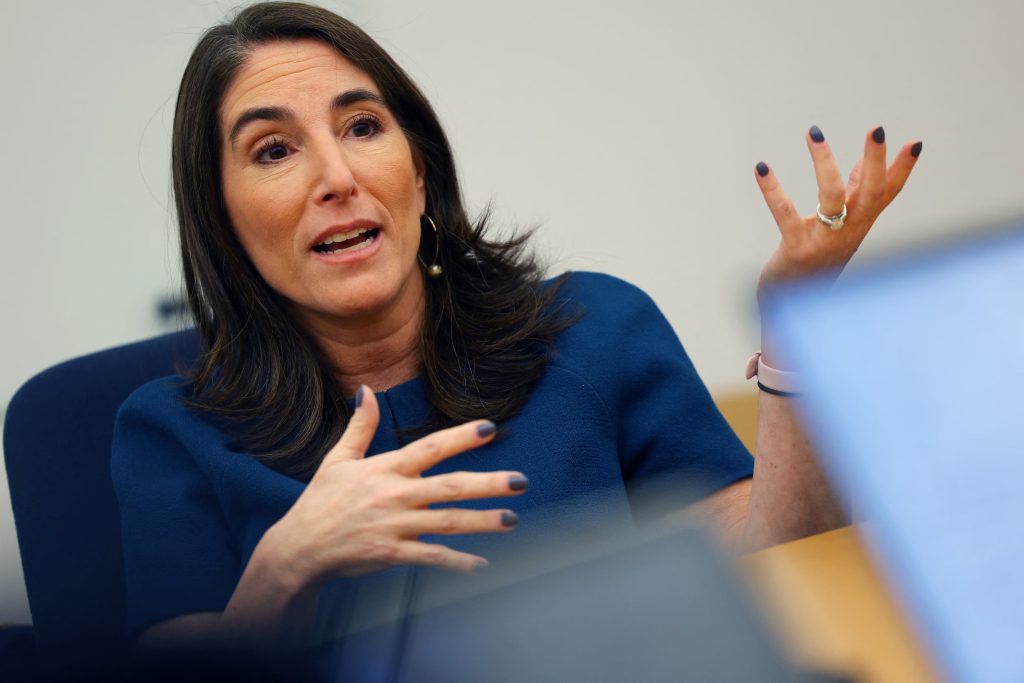
Wolfe Research chief economist Stephanie Roth joined Morning Brief recently to explain how tariffs could start showing up in prices over the next few months. She also explained what it could mean for Federal Reserve interest rate cuts.
When asked about April’s Consumer Price Index (CPI) report, Roth said, “Yeah, it came in a little bit soft. So, 24 basis points month on month. We were looking for 0.27, so really not that that different. I think the key thing for everybody to keep in mind is the tariff impact hasn’t really played out yet. So that should happen in the next couple of months.”
She added, “The good news is, of course, the tariffs are a lot lower than we initially anticipated. So, as of now, you are still seeing some weakness in services, so that’s something to keep an eye on. It does suggest that, certainly on the travel side, the consumer is a little bit softer here. And then the good side, it was a little bit mixed, but overall the net was a little bit soft. We should expect that to change in the next couple of months. I think the key thing that the report brought to light is that the consumer on the travel side is certainly a little bit weak.
Roth warned that, “the tariff impact from April second totally has not made its way onto shelves. So that’s when we anticipate it to actually feed into consumer prices. As of now, they’re selling pre-tariff inventory, which shouldn’t have an effect from a price perspective.”
Where does this leave the Fed and rate cuts?
“The market’s pricing in two cuts for the Fed. We still officially have that in our forecast. The risk is certainly that there is fewer cuts. If we’re sitting here in in Q3 or Q4 of this year, and the economy is holding up quite well, and inflation is elevated, there’s not a great reason for them to be cutting. They’re probably going to want to just wait it out. They were only going to be cutting if we saw a substantial rise in unemployment rate, which, if the tariff impact isn’t that large, there’s not a great reason for companies to be doing big layoffs,” Roth commented.
But housing is such a sticky part of inflation. So how do we get to the Fed’s 2% goal with shelter prices still high?
“We’re not going to get to the Fed’s 2% goal in in the near term. We’re likely to be sitting with inflation closer to 3%. The expectation was that shelter should come down, and we still expect that should be the case, largely because what’s happening real time in market, it’s in the rental market is that prices have slowed down quite a bit. It hasn’t been reflected in CPI, so there’s still this lagged effect where OER and rent should come down. The thing is the tariff impact should more than offset that. So we’re we’re unlikely to be talking about 2% inflation this year,” Roth predicted. “That’s just not the reality. So we’re not going to be at the Fed’s target. The only reason they would be cutting interest rates is because the economy is softening, certainly not because inflation is missing their forecasts.
The Week Ahead:
Monday (5/19): The Conference Board’s Leading Economic Index for the U.S.
Tuesday (5/20): No major reports scheduled but earnings from Home Depot (HD), Palo Alto Networks (PANW), and Toll Brothers (TOL) are on deck.
Wednesday (5/21): No major reports scheduled but earnings will be out for Baidu (BIDU), Target, (TGT), Lowe’s (LOW), Macy’s (M), Medtronic (MDT), TJX (TJX), Urban Outfitters (URBN), and Snowflake (SNOW).
Thursday (5/22): Existing home sales from the National Association of Realtors and weekly unemployment claims from the U.S. Department of Labor. Look out for earnings from Analog Devices (ADI), Ralph Lauren (RL), Ross Stores (ROST), Autodesk (ADSK), Deckers Outdoor (DECK), and Intuit (INTU).
Friday (5/23): New home sales from the U.S. Census Bureau.

 Pump Radar
 Stock Alerts